
We are saddened that Oakland's 21 Grand gallery on 25th St. will close at the end of December. For more information, read this and this.
This series, through its many names and curators, has been generously hosted by 21 Grand for almost a decade, and the venue itself has become a vital part of the series. In recognition and support of this connection, we have decided to take a break until the gallery reopens in a new location. Our hope is that the gallery situates itself in a new spot by the middle of 2011, and that the series resurfaces by the fall. We hope to see you in the next round! Thanks for all your support.
________________________
12/2/10


11/1/10
The (New) Reading Series at 21 Grand presents...
An evening with Tisa Bryant & Jeff Derksen
Sunday, November 21, 2010
Doors open at 6:30 p.m.
Reading at 7 p.m.
at 21 Grand, 416 25th St, Oakland
Admission is 5 dollars
 Tisa Bryant is the author of Unexplained Presence (Leon Works, 2007), a collection of hybrid essays on black presences in film, literature, and visual art. She is co-editor of the cross-referenced journal of narrative possibility, The Encyclopedia Project, and co-editor, with Ernest Hardy, of War Diaries, an anthology on black gay men’s desire and survival, published by AIDS Project Los Angeles in 2010. She is also author of a chapbook, Tzimmes. Her work has recently appeared or is forthcoming in the journals 1913 and Animal Shelter. Bryant is currently working on a novel, The Curator. She teaches fiction, hybrid forms, and ethnic innovative literature at the California Institute of the Arts.
 Jeff Derksen's poetry books include Down Time, Dwell, and Transnational Muscle Cars, as well as the book of essays Annihilated Time: poetry and other politics (all from Talonbooks). His poetry has been anthologized in The Canadian Long Poem Anthology, The Gertrude Stein Anthology of Innovative North American Poetry, Writing Class, Half in the Sun: an anthology of Mennonite Writing, and in the Portuguese anthology of Canadian poetry, Pullllllllllll. His collection of essays on art and urbanism in the long neoliberal moment, After Euphoria (JRP Ringier), is forthcoming. Derksen is on the boards of the Kootenay School of Writing and Artspeak Gallery (Vancouver), and he works at Simon Fraser University.
__________________
We will be taking a hiatus during the months of December and January while we explore options for the series, given the precarious situation at 21 Grand. Please help 21 Grand if you can! For more information, read this article.
 Tisa Bryant is the author of Unexplained Presence (Leon Works, 2007), a collection of hybrid essays on black presences in film, literature, and visual art. She is co-editor of the cross-referenced journal of narrative possibility, The Encyclopedia Project, and co-editor, with Ernest Hardy, of War Diaries, an anthology on black gay men’s desire and survival, published by AIDS Project Los Angeles in 2010. She is also author of a chapbook, Tzimmes. Her work has recently appeared or is forthcoming in the journals 1913 and Animal Shelter. Bryant is currently working on a novel, The Curator. She teaches fiction, hybrid forms, and ethnic innovative literature at the California Institute of the Arts.
 Jeff Derksen's poetry books include Down Time, Dwell, and Transnational Muscle Cars, as well as the book of essays Annihilated Time: poetry and other politics (all from Talonbooks). His poetry has been anthologized in The Canadian Long Poem Anthology, The Gertrude Stein Anthology of Innovative North American Poetry, Writing Class, Half in the Sun: an anthology of Mennonite Writing, and in the Portuguese anthology of Canadian poetry, Pullllllllllll. His collection of essays on art and urbanism in the long neoliberal moment, After Euphoria (JRP Ringier), is forthcoming. Derksen is on the boards of the Kootenay School of Writing and Artspeak Gallery (Vancouver), and he works at Simon Fraser University.
__________________
We will be taking a hiatus during the months of December and January while we explore options for the series, given the precarious situation at 21 Grand. Please help 21 Grand if you can! For more information, read this article.
10/28/10


9/29/10
The (New) Reading Series at 21 Grand presents
An evening with Mina Pam Dick and Evan Kennedy
Sunday, October 17
6:30 pm

Evan Kennedy is the author of a few chapbooks, including Us Them Poems (BookThug), and a video-poem, Voyage by Donkey, with Zbyszek Bzymek. His work has appeared in Try!, The Equalizer, Tight, Poetry Project’s The Recluse, and The Brooklyn Rail. He oversees Dirty Swan Projects out of San Francisco.

Mina Pam Dick (aka Hildebrand Pam Dick, Nico Pam Dick et al.) is a writer, artist and philosopher living in New York City. A native New Yorker, she received a BA from Yale University and an MFA in Painting as well as an MA in Philosophy from the University of Minnesota. Her writing has appeared in Tantalum, BOMB, The Brooklyn Rail, The Portable Boog Reader 4, Aufgabe #9, The Recluse, and Everyday Genius, and is forthcoming in the online journal EOAGH. Her philosophical work has appeared in a collection published by the International Wittgenstein Symposium (Kirchberg am Wechsel, Austria). Her first book, Delinquent, was released by Futurepoem Books in late 2009.
9/22/10


8/22/10
The (New) Reading Series at 21 Grand presents...
An evening with Steven Farmer & N S (Nathalie Stephens/Nathanaël)
Sunday, September 19
6:30 in the evening
at 21 Grand, 416 25th St, Oakland
Admission is 5 dollars Steven Farmer is a southern California native who migrated northward to the Bay Area in the early '80's, where the seeds of his antipoetry sprouted in the Newtonic (Huey) soil of north Oakland. With two English Lit-ish degrees on his wall, he nonetheless works in the IT world (after many years in the restaurant industry). Books include Coracle, Tone Ward, World of Shields, Standing Water, Medieval, and just out from theenk Books , Glowball. Other work appearing in 5 Fingers Review, Try, Crayon, Third Factory/Notes to Poetry, Poetics Journal and elsewhere.

N S (Nathalie Stephens / Nathanaël) writes l'entre-genre in English and French. Her books include We Press Ourselves Plainly (2010),Carnet de désaccords (2009), The Sorrow And The Fast Of It (2007), and Je Nathanaël (2003/2006). Other work exists in Basque and Slovene with book-length translations in Bulgarian. There is an essay of correspondence (2009) : Absence Where As (Claude Cahun and the Unopened Book), first published (2007) as L'absence au lieu. Also, a collection of talks, At Alberta (2008). Besides translating some of her own work, Stephens has translated Catherine Mavrikakis, Gail Scott, John Keene, Édouard Glissant. She lives, she thinks, in Chicago.
__________________
Please note that N S has two other engagements in the Bay Area. On September 23, Nathanaël will read at the Poetry Center w/ Brian Teare. On September 25, Nathanaël will give a talk at SPT.
Please note that N S has two other engagements in the Bay Area. On September 23, Nathanaël will read at the Poetry Center w/ Brian Teare. On September 25, Nathanaël will give a talk at SPT.



7/21/10

The (New) Reading Series at 21 Grand presents
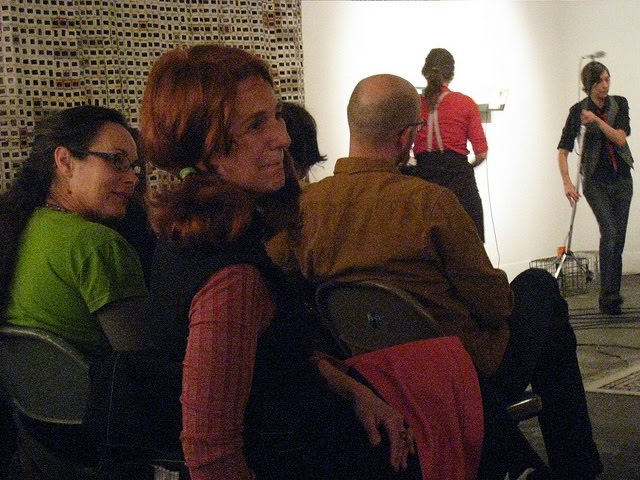
A Summertime Cabaret
This event is a fundraiser for the series, so we can continue to do what we do!
August 15, 2010
6:30 - 9:00 pm
Performers will include:
Lindsey Boldt (with special guests), The Movie La Bamba in 10 Minutes or Less
6:30 - 9:00 pm
Performers will include:
Lindsey Boldt (with special guests), The Movie La Bamba in 10 Minutes or Less
The Newlywed Game, featuring Stephanie Young & Clive Worsley, Lauren Shufran & Carrie Stone, Samantha Giles & Frank Brash; hosted by Ron Palmer
a Short Piece for Videotheater by Konrad Steiner
Margaret Tedesco
Violets (Cliff Hengst, Scott Hewicker, Karla Milosevich, Kota Uetsu)
Lara Durback, Jacob Eichert, and Erin Morrill will be performing refreshments.
Lara Durback, Jacob Eichert, and Erin Morrill will be performing refreshments.
Brandon Brown will be your MC.
Admission $10; additional donations will not be refused
Spirits available
Goods for sale
See you at 21 Grand
416 25th St, Oakland
Admission $10; additional donations will not be refused
Spirits available
Goods for sale
See you at 21 Grand
416 25th St, Oakland
7/20/10


6/28/10
Please join us at 21 Grand on Sunday, July 18, 2010 as we welcome
Thom Donovan & Catherine Meng
Doors at 6:30pm
5 USD Admission
21 Grand, 416 25th St, Oakland

Thom Donovan lives in NYC where he edits Wild Horses of Fire weblog (whof.blogspot.com) and coedits ON Contemporary Practice. He is a participant in the Nonsite Collective and a curator for the SEGUE reading series. His criticism and poetry have been published widely in BOMB, PAJ: performance + art, Modern Painters, The Brooklyn Rail, and at the Poetry Foundation's Harriet blog. Currently he is working on a book of criticism, Sovereignty and US: Critical Objects 2005-2010, and on the Project for an Archive of the Future Anterior (with Sreshta Rit Premnath). His book The Hole is forthcoming with Displaced Press.

Catherine Meng is the author of the poetry collection Tonight's the Night (Apostrophe Books) and three chapbooks, 15 Poems in Sets of 5 (Anchorite Press), Dokument (Perichord Press), and Lost Notebook w/ Letters to Deer (Dusie Kollectiv). She lives in Berkeley unironically and works at a restaurant. Along with Lauren Levin and Jared Stanley she co-edits the poetry journal Mrs. Maybe.


6/1/10
The (New) Reading Series at 21 Grand Presents...Jeffrey Schrader & K. Lorraine GrahamSunday, June 20, 20106:30 pm, Admission 5 USD@ 21 Grand, 416 25th Street, Oakland Jeffrey Schrader’s newest book is Art Fraud (BlazeVOX 2010). This summer his newest work will be gridpattern (www.ErgArts.com). He has previous work in a handful of diy journals & websites. He has some older chapbooks. He’s worked as a factory employee, an outdoor adventure guide for young, urban troublemakers, an arts academy teacher, a bike messenger, a student, an archivist, a recipient of unemployment benefits, and an accountant. He does not blog, but enjoys reading yours. He has occasionally helped out with The Uglyman Collective, Another Thing Books, and (currently) Cricket Online Review. He presently lives in Oakland, CA, but he won’t live there forever. He has received no grants or awards.
 K. Lorraine Graham is a writer and visual artist. She is the author of Terminal Humming (Edge Books, 2009) and several chapbooks, including Large Waves to Large Obstacles, forthcoming from Take-Home Project. Her work has appeared or is forthcoming in Traffic, Area Sneaks, Foursquare and elsewhere. She currently lives in southern California with her partner, Mark Wallace, and Lester Young, a pacific parrotlet.


Subscribe to:
Posts (Atom)


